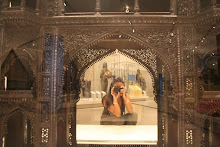
Corteo (pronounced /korˈteɪ.oʊ/) is a Cirque du Soleil touring production that premiered in North America in 2005.
Corteo, which means "cortege" in Italian, is a joyous procession, a festive parade imagined by a clown. The show brings together the passion of the actor with the grace and power of the acrobat to plunge the audience into a theatrical world of fun, comedy and spontaneity situated in a mysterious space between heaven and earth.
The clown pictures his own funeral taking place in a carnival atmosphere, watched over by quietly caring angels. Juxtaposing the large with the small, the ridiculous with the tragic and the magic of perfection with the charm of imperfection, the show highlights the strength and fragility of the clown, as well as his wisdom and kindness, to illustrate the portion of humanity that is within each of us. The music, by turns lyrical and playful, carries Corteo through a timeless celebration in which illusion teases reality. courtesy of wiki
Tightwire Act - CORTEO (Cirque du Soleil)31,006 views 8.5.2009 2.29AM est.
...Cirque Du Soleil - El Cielo Sabrá new note 8.5.2009 2.59AM est.
porque, el no regresa siempre al mar because, if not returned to the sea
porque, como un niño preguntare because as a child ask
con mi voz, con mis palabras with my voice, my words
te miro y te quiero, tu sonrisa sin mi cielos I look at you and love you, your smile without my heavens
busco después me pierdo looking after me lose
pregunto y ya me duermo I sleep and I wonder
busco después me quedo I am looking after
pregunto y ya despierto already awake and wonder
sabrás, tu lo sabrás porque porque porque el porque porque porque you know, you know because because because because because because

porque, solo el viento sabrá because the wind only knows
porque, las nubes no se pueden parar because the clouds can not stop
porque, como un niño preguntare because as a child ask
con mi voz, con mis palabras with my voice, my words
te miro y te quiero, tu sueñas sin dormir la noche I look at you and I love you, your dream sleepless night
busco después me pierdo looking after me lose
pregunto y ya despierto already awake and wonder
sabrás, tu lo sabrás porque porque porque you know, you know it because it
solo libertad only freedom
Buena Vista Social Club - Chan Chan
688,455 views end note 3.18AM est.
Chan Chan (song)
From Wikipedia, the free encyclopedia

"Chan Chan" is a son composition by Cuban bandleader Compay Segundo, revolving around two central characters, 'Juanica' and 'Chan Chan'.[1] The song was one of Compay's last compositions and was written in 1987.[2] "Chan Chan" was recorded by Segundo himself various times as well as by many other Latin artists. A version of "Chan Chan" with Compay and other Cuban artists Eliades Ochoa and Ibrahim Ferrer is the first song on the album Buena Vista Social Club. This version of "Chan Chan" became a worldwide success and its first four chords are among the most well-known in Cuban music.
[edit] Comments

Compay Segundo textual cite:
I didn't compose Chan Chan, I dreamed it. I dream the music. I sometimes wake up with a melody on the head, I hear the instruments, all very clear. I look over the balcony and I see nobody, but I hear it as if it was played on the street. I don't know what it was. One day I woke up listening to those four sensible notes, I put them a lyric inspired on a children tale from my childhood, Juanita y Chan Chan, and you see, now it's sung everywhere.
A fan that met Compay Segundo back on 1989, said[3] that: 'Chan Chan and his girlfriend Juanica shake a jibe to sift sand on the edge of the sea. Juanica looked so sensual shaking the jibe that Chan Chan felt shame that other people saw them.'
The most complete explanation[4] says: 'The song relates the story of a man and a woman (Chan Chan and Juanica) who are building a house, and go to the beach to get some sand. Chan Chan collects the sand and puts it on the 'jibe'. Juanica shakes it, and to do so she shakes herself, making Chan Chan ashamed. [...] The origin of this tale is a farmer song learnt by Compay Segundo when he was twelve years old.'
Kevin Skinner 35 Unemployed Farmer Americas Got Talent June 30 286,599 views

The "America's Got Talent" auditions headed back to New York City on Tuesday night in search of the country's greatest new act and the eventual winner of the $1 million grand prize.
Alto Cedro, Marcané, Cueto and Mayarí, names are repeated several times, as are four towns near each other in Holguín Province, on the east side of Cuba.
Chan Chan
The 11th Hour Trailer 788,649 views

Film site: www.11thhourfilm.com
From Wikipedia, the free encyclopedia
Coordinates: 8°6′40″S 79°04′32″W / 8.11111°S 79.07556°W

| Chan Chan Archaeological Zone* | |
|---|---|
| UNESCO World Heritage Site | |
 | |
| State Party |  Peru Peru |
| Type | Cultural |
| Criteria | i, iii |
| Reference | 366 |
| Region** | Latin America and the Caribbean |
| Inscription history | |
| Inscription | 1986 (10th Session) |
| Endangered | 1986- |
| * Name as inscribed on World Heritage List. ** Region as classified by UNESCO. | |

Chan Chan was added as a Unesco World Heritage Site in 1986. The city is severely threatened by tornados from El Niño, which causes heavy rains and flooding on the Peruvian coast. It is in a fertile, well-watered section of the coastal plain.[2] The city's ruins are additionally threatened by earthquakes and looters. Present-day visitors to Chan Chan can enter the Tschudi Complex, believed to be one of the later citadels built in the city. There are also several other Chimú and Moche ruins in the area around Trujillo. This site was discovered by the Conquistador Francisco Pizarro.

Architecture
The city is composed of ten walled citadels which housed ceremonial rooms, burial chambers, temples, reservoirs and some residences. Chan Chan is a triangular city surrounded by walls 50-60 feet high. A distinguishable aspect of Chan Chan is that there are no enclosures which open to the north. The tallest walls shelter against south-westerly winds from Peru's coast. Northern-facing walls gain the greatest exposure to the sun, serving both to block the wind and absorb sunlight where fog is frequent. The numerous walls throughout the city create labyrinth of passages.

The walls themselves were constructed of adobe brick and were then covered with a smooth surface into which intricate designs were carved. There are two styles of design present in these carvings: one is a ‘realistic’ representation of subjects such as birds, fish, and small mammals; and the other is a more graphic, stylized representation of the same subjects. The carvings at Chan Chan depict crabs, turtles, and nets for catching various sea monsters. Chan Chan, unlike most other coastal ruins in Peru, is located extremely close to the Pacific Ocean. In 1998, The "Master Plan for Conservation and Management of the Chan Chan Archeological Complex" is drawn up by the Freedom National Culture Institute of Peru with contributions from the World Heritage Foundation - WHR, ICCROM and GCI. The Plan is approved by the Peruvian Government, with involvement at the highest levels up until today.

[edit] Threats to Chan Chan
As the world's largest adobe city, the ancient structures of Chan Chan are today threatened by erosion due to changes in weather patterns - heavy rains, flooding, strong winds. According to the Peruvian Times, "Heavy rains are causing widespread damage to ancient ruins in Peru’s normally arid northern coast, says a regional director from the National Institute of Culture, INC."[3]

Bruce Hathaway, writes about the engangered site at Chan Chan in the Smithsonian Magazine, March 2009:
Chan Chan's days of glory came to an end around 1470, when the Inca conquered the city, broke up the Chimú Empire and brought many of Chan Chan's craftsmen to their own capital, Cuzco, 600 miles to the southeast. By the time Spanish conquistador Francisco Pizarro arrived around 1532, the city had been largely abandoned, though reports from the expedition described walls and other architectural features adorned with precious metals. (One of the conqueror's kinsmen, Pedro Pizarro, found a doorway covered in silver that might well have been worth more than $2 million today.) Chan Chan was pillaged as the Spaniards formed mining companies to extract every trace of gold and silver from the city.

Chan Chan was left to the mercy of the weather. "The Chimú were a highly organized civilization" and any water damage to the adobe-brick structures of Chan Chan "could be repaired immediately," says Claudia Riess, a German native who now works as a guide to archaeological sites in northern Peru. Most of the damage to Chan Chan during the Chimú reign was caused by El Niño storms, which occurred every 25 to 50 years.

Now they occur more frequently. Riess believes that climate change is a primary cause of the increasing rainfall—and she's not alone. A 2007 report published by Unesco describes the erosion of Chan Chan as "rapid and seemingly unstoppable" and concludes "global warming is likely to lead to greater extremes of drying and heavy rainfall." Peru's National Institute of Culture is supporting efforts to preserve the site. Tentlike protective structures are being erected in various parts of the city. Some friezes are being hardened with a solution of distilled water and cactus juice, while others have been photographed, then covered to protect them. Panels with pictures of the friezes allow visitors to see what the covered artwork looks like.
Riess believes the best solution for Chan Chan would be a roof that stretches over the entire area and a fence to surround the city. But she acknowledges that both are impractical, given the ancient capital's sheer size. Meanwhile, the rains continue, and Chan Chan slowly dissolves from brick into mud.[4]
Source: "Endangered Site: Chan Chan, Peru" by Bruce Hathaway, Smithsonian Magazine, March 2009
The full article can be found at Endangered Site: Chan Chan, Peru
Andrew Curry writes about changes in weather patterns that affect ancient sites in his article "Climate Change: Sites in Peril", in the publication Archaeology:
Leonardo DiCaprio's YouTube Message 274,623 views
ARE YOU TAKING ACTION? SEND US YOUR VIDEOS.
Video your action and put it up on YouTube and send us the link and we'll put it up. The best we'll put up on our channel.
http://www.11thHourFilm.com
http://www.11thHourAction.com
Peru's Rainstorms
The civilizations that rose and fell in the bone-dry deserts of coastal Peru knew the signs well. When Spanish conquistadors arrived, they noticed its effects around Christmas, and named the phenomenon El Nino, or little boy, after the Christ child. Every seven to ten years, currents in the Pacific Ocean shift, changing weather patterns from Australia to California. In Peru, El Nino means warmer water, and heavy rainfall along the coast.
The difference between a normal and a bad El Nino year can be tremendous. Peru's deserts typically get just over an inch of rain per year. In 1998, the last severe El Nino season, the region was doused with 120 inches, which caused serious flooding. Water takes a heavy toll on exposed archaeological sites, many of which are located along rivers or on easily eroded slopes.
August 8th, 2009 - Typhoon Morakot, ChiaYi, Taiwan - Overtopping of Dam in South ChiaYi 1,391 views

Ironically, archaeologists have made the problem worse. "If we don't mess with the sites, water runs off without doing too much damage," says University of Maine archaeologist Dan Sandweiss. "But if you excavate, that's the end of them, basically." Holes made by looters also channel and trap moisture, doing more damage.
Take Chan Chan, an elaborately planned city eight miles square that dates back 1,000 years. Made of unfired mud brick, Chan Chan's pyramids and palaces were put on UNESCO's list of World Heritage Sites in Danger in 1986 because they were threatened by erosion. Over the past two decades, the site has deteriorated steadily. Researchers are investigating whether global warming could make El Nino occur more frequently. "There's the potential for greater destruction if the pace of El Nino events increases," says Sandweiss.
Bruce Springsteen - TV Acoustic 2006 81,150 views

So far, climatologists can't say for sure what climate change will do to the powerful weather phenomenon. "The models are all over the place," says National Oceanic and Atmospheric Administration climatologist David Enfield. "We're up against a huge uncertainty at present." As climate experts work to refine their predictions, archaeologists anxiously await the arrival of the next El Nino.[5]
Source: "Climate Change: Sites in Peril" Andrew Curry, Archaeology - A Publication of the Archaeological Institute of America, Volume 62 Number 2, March/April 2009
The full article can be found at Climate Change: Sites in Peril
wow i just heard a big thunder strike...it was just sunny.......