Morenito - Stephane Pompougnac feat.Clementine 53,419 views

Pic: album cover Hotel Costes 6

desde o tempo vida pura
j? pensando quando cresceu
que a tarde nos reserva do prazer
na pureza um sonho, simples sem maldade
uma vida, uma vida toda
inoc?ncia vem te dizer, que demais.
Amor, je n'oubli? pas
morenito, ni deux yeux ont dit par moi
amor, tu n'oubli? pas
morenito, ni nous jour, ni nous joie, oui ni nous joie
Na primeira vez com voc?
foi pra mim uma loucura
quanto tempo pra me dizer...
OUR LOVE....
"...sonhos e saudades,
e felicidades,
uma vida, nossa vida,
se existe ? ????? pra você,
que demais!"
<3<3<3<3<3<3<3<3<3<3<3<3<3<3<3<3<3<3<3<3<3<3<3<3<3<3<3<3<3<3<3
IN MY DREAMS
WHY HAVE YOU COME
SLEEPING LAST NIGHT THINKING OF YOU
WHY DID YOU HAVE TO VISIT
YOU WERE LYING THERE AND I MISSED YOU
YOU DON'T ALWAYS VISIT ME
LYING THERE WITH ME
IT'S BEEN A LONG TIME NOW THAT YOU'RE BESIDE ME
MY HAND ON YOUR HEART
I ASKED WHERE DID YOU GO WHERE WERE YOU
YOU DIDN'T SAY ANYTHING
YOU SMILED...................................................
I ASKED WHY YOU CAME BACK
WHERE ARE WE
IN HEAVEN
IT'S BEEN SO LONG SINCE YOU VISITED ME
YOU SMILED...................................................
YOU CAME BACK WHY?
BECAUSE YOU WERE CRYING FOR ME
WHY BECAUSE YOU WANTED TO SAVE ME
YOU SMILED...................................................
I'M LONELY WITHOUT YOU
LIKE YESTERDAY
I NEED YOU
WAKE UP
I CRIED FOR YOU
LOVE
by p.m.w
<3<3<3<3<3<3<3<3<3<3<3<3<3<3<3<3<3<3<3<3<3<3<3<3<3<3<3<3<3<3<3

Tu vem vibrar comigo sem ver
desde o tempo vida pura
j? pensando quando cresceu
que a tarde nos reserva do prazer
na pureza um sonho, simples sem maldade
uma vida, uma vida toda
inoc?ncia vem te dizer, que demais.
Amor, je n'oubli? pas
morenito, ni deux yeux ont dit par moi
amor, tu n'oubli? pas
morenito, ni nous jour, ni nous joie, oui ni nous joie
Na primeira vez com voc?
foi pra mim uma loucura
quanto tempo pra me dizer,
e esse momento lindo aparecer
sonhos e saudades...
Soulmate
From Wikipedia, the free encyclopedia
 |
| Types of relationships Major relationship events Feelings and emotions Human practices Relationship abuse |
Soulmate is a term sometimes used to designate someone with whom one has a feeling of deep and natural affinity, love, intimacy, sexuality, spirituality, and/or compatibility. A related concept is that of the twin flame or twin soul – which is thought to be the ultimate soulmate, the one and only other half of one's soul, for which all souls are driven to find and join. However, not everyone who uses these terms intends them to carry such mystical connotations.
[edit] Theories
One theory of soulmates, presented by Aristophanes in Plato's Symposium, is that humans originally consisted of four arms, four legs, and a single head made of two faces, but Zeus feared their power and split them all in half, condemning them to spend their lives searching for the other half to complete them:
[Primeval man] could walk upright as men now do, backwards or forwards as he pleased, and he could also roll over and over at a great pace, turning on his four hands and four feet, eight in all, like tumblers going over and over with their legs in the air; this was when he wanted to run fast …Terrible was their might and strength, and the thoughts of their hearts were great, and they made an attack upon the gods ... Doubt reigned in the celestial councils. Should they kill them and annihilate the race with thunderbolts, as they had done the giants, then there would be an end of the sacrifices and worship which men offered to them; but, on the other hand, the gods could not suffer their insolence to be unrestrained. At last, after a good deal of reflection, Zeus discovered a way. He said: 'Methinks I have a plan which will humble their pride and improve their manners; men shall continue to exist, but I will cut them in two and then they will be diminished in strength and increased in numbers; this will have the advantage of making them more profitable to us. They shall walk upright on two legs, and if they continue insolent and will not be quiet, I will split them again and they shall hop about on a single leg.'
—Aristophanes, Plato’s Symposium, [1]

Some people[vague][who?] believe that souls are literally made and/or fated to be the mates of each other, or to play certain other important roles in each other's lives.
According to theories popularized by Theosophy and in a modified form by Edgar Cayce, God created androgynous souls, equally male and female. Later theories postulate that the souls split into separate genders, perhaps because they incurred karma while playing around on the Earth, or "separation from God". Over countless reincarnations, each half seeks the other. When all karmic debt is purged, the two will fuse back together and return to the ultimate.[2][3][4]
[edit] See also
- Astrological compatibility
- Astrology
- Cosmology
- Interpersonal relationship
- Love
- New Age Spirituality
- Romantic love
[edit] Notes and references
- ^ The Internet Classics Archive | Symposium by Plato
- ^ Krajenke, Robert W. (1972). Suddenly We Were!: a Story of Creation Based on the Edgar Cayce Readings. A.R.E. Press.
- ^ "What is a Twin Flame?". SoulEvolution.org. Retrieved on 2007-12-21.
- ^ "Twin Flames and Soul Mates: The Quest for Wholeness", tsl.org. Retrieved on 2007-12-21.
- Segal, E. (ed) (1986). The Dialogues of Plato New York, N.Y.: Bantam Books. ISBN 055321327X.
Natural philosophy
From Wikipedia, the free encyclopedia
- For the current in the 19th century German idealism, see Naturphilosophie
Size of this preview: 800 × 548 pixels
Full resolution
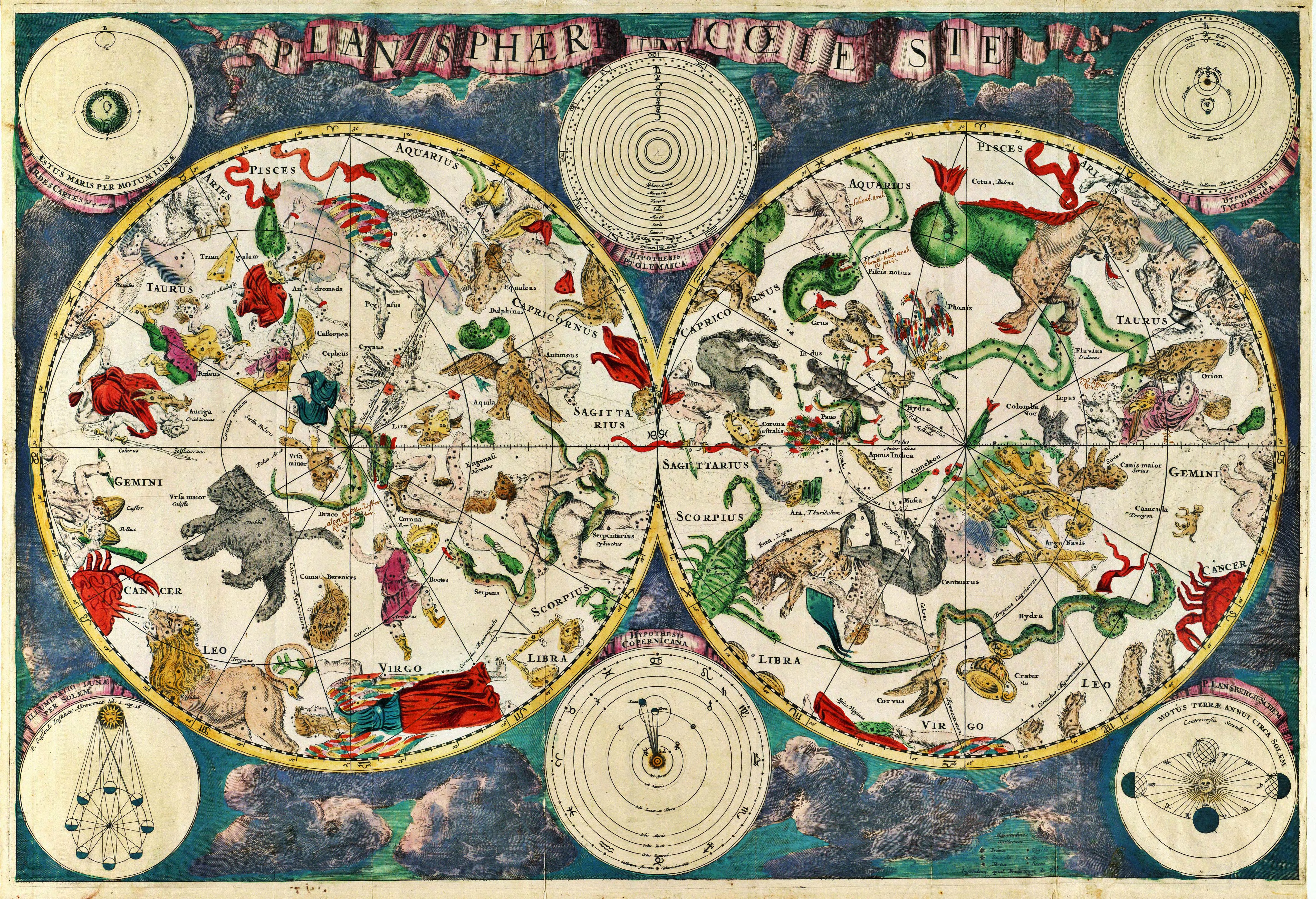
A celestial map from the 17th century, by the Dutch cartographer Frederik De Wit.
Natural philosophy or the philosophy of nature (from Latin philosophia naturalis), is a term applied to the study of nature and the physical universe that was dominant before the development of modern science. It is considered to be the precursor of natural sciences such as physics.
Forms of science historically developed out of philosophy or more specifically natural philosophy. At older universities, long-established Chairs of Natural Philosophy are nowadays occupied mainly by physics professors. Modern notions of science and scientists date only to the 19th century (Webster's Ninth New Collegiate Dictionary dates the origin of the word "scientist" to 1834). Before then, the word "science" simply meant knowledge and the label of scientist did not exist. Isaac Newton's 1687 scientific treatise is known as The Mathematical Principles of Natural Philosophy.